Time is flying here in Spain! I can’t believe I’ve been gone for a month already.
On Saturday, I went to Salamanca, which is about two hours northwest of Madrid. The same SLU professor that led last weekend’s trips led this one. He knows so much of the history of Spain and about each of these cities! It was very interesting!
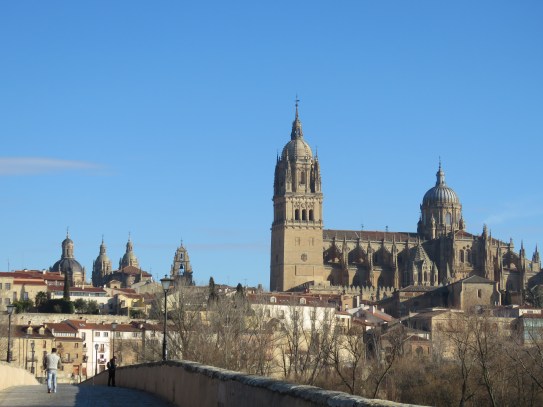
We saw the Cathedral of Salamanca. It was huge! We toured both the new and the old Cathedrals. The new Cathedral was built directly next to the old Cathedral when they decided they needed a bigger church for their growing city. The two churches literally share a wall, so you don’t even need to go outside to go from one to the other.
The old Cathedral was smaller but still very beautiful. Interestingly, there was very little writing on the walls because when the Cathedral was in use, many people were illiterate. They used the pictures on the walls to tell the Gospel stories.


The new Cathedral was absolutely huge and beautiful. We walked around and Julio, the SLU professor, told us about the statues of the saints and the history of the Cathedral.


Next, we went to University of Salamanca, which is the fourth oldest university in Europe, founded in 1218. As we approached the university, we heard a “ribbet” sound – like the sound frogs make! It was very strange. Legend has it, that if you can find the frog in the stone carvings on the main building of the university, you will have good luck. We did find the frog, so maybe we will all have good luck this semester 🙂 Look on the head of the skull below, and you can see it!


We also went to the Jesuit church in Salamanca. The church was beautiful but it was hard to see the entire building! When it was built, it was so close to the building next to it, that you could not see the entire building. We went up into the bell tower and got to see an incredible view of Salamanca! It was definitely worth the many steps.


On Sunday, we went to Segovia, which is about an hour northwest of Madrid. As the bus pulled up to the city, we saw the huge and beautiful aqueduct that was built in the first or second century. The aqueduct is 818 meters long and has about 25,000 granite blocks. It is still used to deliver water today.


We then went to the Alcazar of Segovia, the royal palace. The palace was first documented in 1122, but it could have been built earlier. We got a tour of most of the castle, which was really cool, and then we went the top and had a beautiful view of the city – especially of the Segovia Cathedral.


Finally, we went into the Segovia Cathedral. The Cathedral was the last gothic style church built in Europe. It was absolutely incredible… probably my favorite of all of the churches I have seen so far! It was massive. I loved wandering around and looking at all of the statues and paintings.


Tonight, six of my roommates, a few other friends from school, and I leave for Morocco! We have an overnight bus, an hour ferry ride, and then we will be in Tangier tomorrow morning! I can’t wait to ride a camel, walk along the beach, and try some awesome Moroccan food.
Katie
 Katie's Adventures Abroad
Hi Katie,
This is your old Grandmother A speaking to you. I enjoy reading all your blog messages. They are interesting and you have beautiful pictures. Have a question about the aquaduct???? Where is the water? The structure is so narrow and tall.
I look forward to your blog about the camel.
Love you,
Grandma A
LikeLiked by 1 person
We are truly enjoying hearing from you and love all your pictures. Enjoy Morocco. (My sister Mollie and her family spent a year there when her husband was in the Navy.) 💕PapPap & T
LikeLiked by 1 person